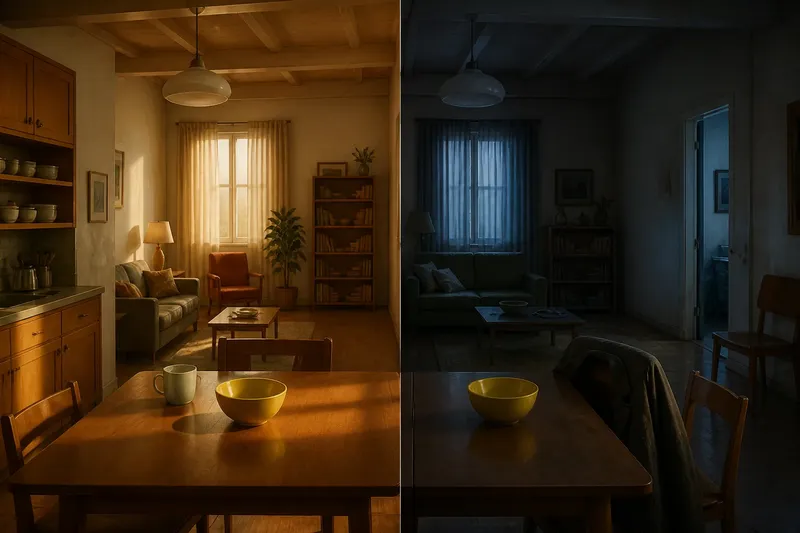
Built Set or Found Location: Two Ways to Shape a Screen World
Built set or found location: see how control, weathering, light, and framing shape a scene, and choose the setting that best serves its visual purpose.
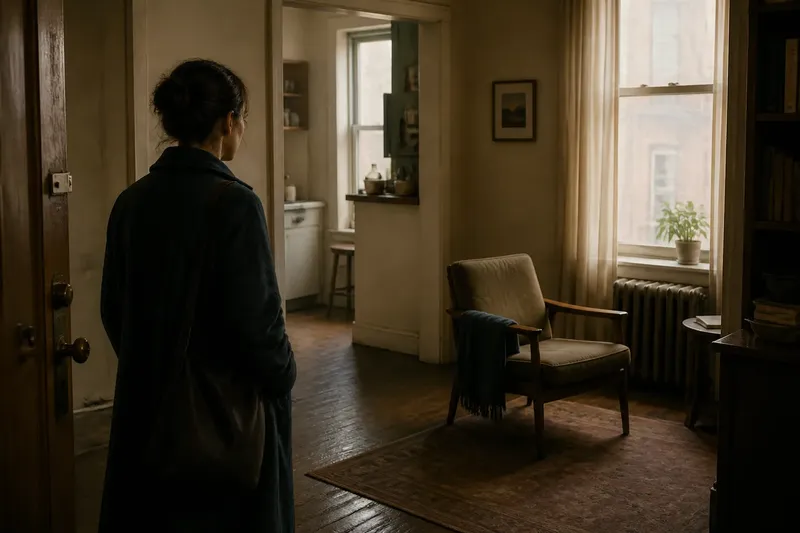
A built set gives a film crew control over the room; a found location gives the room a life that was already there. In the built set or found location decision, the useful question is not which looks more convincing in the abstract. It is which source of visual information the scene needs, and which compromises its design can use.
Consider an invented situation: a director is staging a quiet scene in which a daughter returns to the apartment where her mother lived. The daughter enters, notices a chair left at an angle, and sits beside a window without speaking. The scene needs to feel intimate, but the apartment should also suggest a life that continues beyond the conversation. A production designer and cinematographer compare two options: build the apartment on a stage, or adapt an existing one.
The walk-through below follows that decision from the first sketch to the finished frame. The choices are hypothetical, but the visual trade-offs are practical: a set can be shaped around the camera, while a location brings details that no design team had to invent.
What does the scene need the room to say?
Before choosing a place, the team writes down what the audience should notice. In this scene, the chair matters because it is slightly out of place. The window matters because the daughter avoids looking through it. The rest of the apartment should imply routine rather than announce a backstory.
That distinction helps separate essential features from attractive distractions. A location might have a handsome tiled hearth, a striking view, and a narrow passage to the kitchen. Those details can enrich the frame, but they may pull attention from the chair. A set can omit the hearth and view, then place the passage exactly where the scene needs a glimpse of ordinary domestic life.
The team also asks what the room must allow the actors and camera to do. Can the daughter cross from the door to the chair without turning her back to the lens? Can the camera hold both her profile and the empty seat? Is there a believable place for the light to come from? These are not requests for a room to look good in every direction. They are requests for the specific directions the scene will use.
Write down the scene’s visual priorities before touring spaces.
What can a built set control?
For the stage option, the designer draws the apartment around the planned action. The entry door sits where the daughter can come into the composition. The chair has room beside it for a camera position that catches her hesitation. A partial kitchen wall can provide depth in the background without hiding the window.
That is the central advantage of a set: its geometry can answer the needs of the shot. Walls may be removable or shortened to allow the camera to move. A ceiling can be omitted where overhead equipment must go. The window can be placed to support a chosen direction of light, and the team can control how much of the view appears through it.
Control also reaches into small details. The designer can decide how worn the floor looks between the door and chair, where paint has dulled around a light switch, and which objects remain on a shelf. Each choice can point toward repeated use without turning the apartment into a display of clues. The set’s history is constructed, but it can still feel specific if the wear follows plausible habits.
The trade-off is that every visible detail needs to be supplied or deliberately left out. A room with too few objects may feel like a stage; one loaded with carefully distressed surfaces may look as if it is auditioning for the audience’s attention. Controlled does not have to mean immaculate, but it does mean the design team is responsible for making the room’s irregularities feel coherent.
For the imagined apartment, the team builds only the parts that enter the scene: the doorway, the window wall, a stretch of hall, and enough adjoining room to establish depth. The production does not need a complete home if the frame never asks the audience to see one.
What does a found location retain?
An existing apartment brings accumulated detail. The floor may be worn more heavily near the kitchen. A radiator may sit under the window. The door could open into a cramped hall rather than a convenient stretch of blank wall. Those features have relationships to one another before the film crew arrives.
This can make a location feel inhabited without asking the design team to manufacture every trace of use. The room’s irregularities may suggest how people move through it: a clear strip across a crowded floor, a faded patch where furniture once stood, or a shelf that seems to have acquired objects over time. Such details are useful when the story needs a setting to feel larger than the scene.
But the location retains features the crew may not want. A window might face the wrong way for the intended light. A neighboring building could dominate the view. The room may be too narrow for the camera to hold both the daughter and the chair. A floor plan that makes sense for daily living may work poorly for a carefully composed shot.
In the hypothetical apartment, the director visits an existing unit with a convincing, uneven floor and a narrow entry. The chair can sit beside the window, but the camera cannot see the daughter’s face and the empty seat at once. Moving the chair clears the lens but weakens the scene’s original blocking. Keeping it in place preserves the room’s character while requiring a more limited frame.
That is not automatically a failure. The location’s constraint may support the scene: the daughter can appear partly obstructed by the doorframe, as if she has not quite entered the room. The same restriction may also make the silence feel cramped. A location’s accidental geometry becomes useful only if the filmmakers can make it serve the scene.
How does the choice change the frame?
On the built set, the cinematographer can plan a composition around the chair and window, then adjust the wall opening to hold both in view. The daughter enters at one edge of the frame; the chair remains visible in the background. The room can guide attention through layout rather than through a conspicuous camera move.
At the location, the frame may have to accept a doorframe or radiator as part of the composition. These can add layers: a foreground edge, the daughter in the middle distance, and the window beyond. But they also compete for visual emphasis. The camera may need a different height or angle, and a wide view may reveal more of the room than the scene can use.
Neither option owns depth. A set can create it through overlapping doorways, carefully placed furniture, and controlled sightlines. A location may offer it naturally, or it may be a shallow box with little room to arrange objects. The relevant question is not whether the room has depth in architectural terms, but whether the chosen camera position can show a useful relationship between foreground, actor, and background.
For the invented scene, imagine the team choosing the existing apartment and reframing from just inside the entry. The door edge partly masks the daughter as she pauses, while the chair remains visible beyond her. The expected observable result is a composition that makes the act of entering feel hesitant without adding dialogue or a new prop. It is one solution, not proof that locations are inherently more expressive.
What happens when the room meets the crew?
A setting has to work for more than the finished frame. The cast needs space to perform; the camera needs room to operate; lighting equipment needs a place to stand. A location may require the crew to work around stairs, low ceilings, fragile surfaces, or narrow routes for moving equipment. A set can be designed to leave those routes open, though that space has to be planned rather than assumed.
Light is a particularly clear point of difference. A real window comes with a fixed position and a view that may change the scene’s visual character. The crew can shape the light entering it, but the location’s geometry still determines where that source appears relative to the actors. On a set, a window opening can be positioned for the composition and made accessible for lighting from outside the room.
The distinction is not simply natural light versus artificial light. Both settings may use controlled sources, and both may use daylight. The difference is how much the physical room dictates the available angles and sightlines. If a scene depends on a precise shift of light across the daughter’s face, a set may make that arrangement easier. If the scene benefits from a window view that makes the apartment feel connected to an ordinary street, a location may supply a more persuasive context.
Practical access matters, too. If the scene includes repeated movement through the doorway, a narrow hall can complicate camera placement and sound recording. A set can widen the passage while keeping the frame’s apparent dimensions. A location can preserve the authentic proportions but may restrict how the scene is covered. The team should consider these conditions during the decision, not after the room has already become the plan.
Which option fits the imagined apartment?
After comparing the two, the production chooses the existing apartment. The scene depends on an unforced sense of accumulated domestic life, and the location’s uneven floor and narrow entry supply that without filling the room with decorative evidence. The team accepts a tighter composition and gives up the idea of showing the daughter and chair together from a broad angle.
The choice is not a blanket preference for real rooms. The deciding factor is that the location’s retained details support the scene more than the set’s added flexibility would. If the scene instead required a clear view from the doorway through the kitchen to the window, or a sequence of camera positions unavailable in the apartment, a set might be the more direct solution.
A mixed approach is also possible. A production can use a real exterior and build an interior, or adapt one part of a location while extending it with set construction. The design question then becomes which elements must remain physically connected and which can be adjusted for the camera. This works best when the join between them does not make the room feel like two competing ideas.
For the hypothetical scene, the director keeps the chair in its original position, removes a bright object that distracts from it, and places the camera near the entry. The daughter’s pause, the partly blocked view, and the room’s existing wear now point in the same direction. The result should feel like a particular apartment rather than a collection of signals about grief.
What should you ask before committing?
Can the camera see the detail the scene depends on?
Check the actual camera positions, not only the room from the doorway. A feature that matters in the script may disappear behind an actor, a wall, or furniture once the scene is blocked.
Which details arrive with the location?
Separate useful existing character from visual noise. The former can make a room feel lived in; the latter may compete with the action or demand removal.
Can the set support the needed movement?
Think through entrances, actor marks, camera paths, and lighting access together. A room that accommodates one attractive frame may still obstruct the scene’s necessary action.
Does the setting’s visual character belong to this scene?
Ask whether the room’s order, wear, view, and proportions reinforce the intended mood. If they pull against it, decide whether that tension is meaningful or merely inconvenient.
What does the choice teach the next scene?
The invented apartment shows why built set or found location is a design decision rather than a contest between artificial and authentic. A set lets the crew author the room’s geometry and visible history around the camera. A location preserves relationships and traces that already exist, while asking the crew to work within its fixed conditions.
For the daughter’s return, the existing apartment is selected because its restrained signs of use give the scene enough life, even after the frame is narrowed. The team loses some freedom and gains details that would be awkward to manufacture. In another scene, those priorities could reverse.
Choose by naming what the room must let the audience see, what it should suggest, and what the camera must be able to do. Then inspect a real space or sketch a set against those demands. The phrase built set or found location is useful only after the scene has made clear what it needs from a room.