The Centre-of-the-Frame Myth: How Off-Center Composition Directs Attention
Off-center composition can make a film image more expressive by directing attention to space, relationships, and details beyond its central subject.
The centre of the frame is not a throne, and the most important figure in a shot does not have to sit on it. Off-center composition can direct attention toward a glance, an empty doorway, a second character, or the space between people. The placement matters because viewers read the whole image, not just its most prominent face.
These five ways of thinking about off-center placement show how a composition can guide attention without simply pointing at its leading subject.
1. What does the empty space ask us to notice?
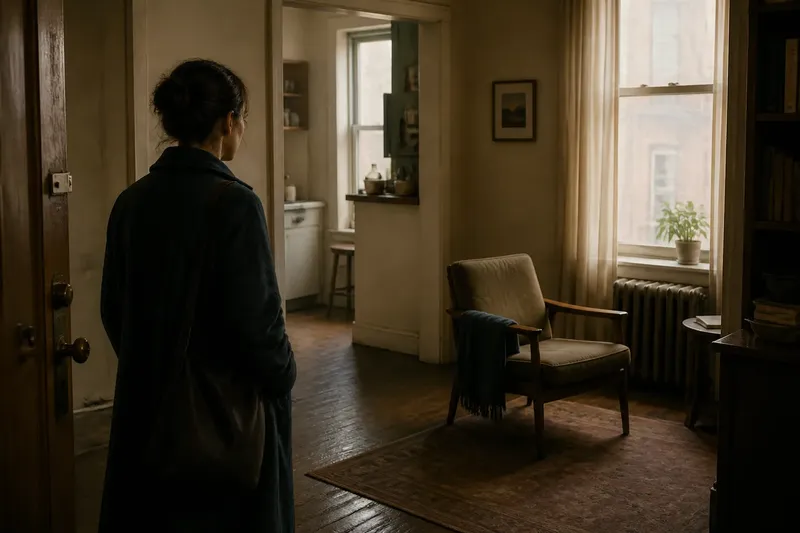
Negative space is the area left open around a subject. It may be a blank wall, a stretch of pavement, or the dark interval between a person and a doorway. When a character is placed near one edge, that space becomes an active part of the shot. The viewer may begin looking for what could enter it, what has just left it, or why the character seems separate from it.
This is not a rule that empty space always signals loneliness or danger. Its effect depends on the other visual cues in the image: the character’s posture, the direction of a gaze, the shape of the set, and the contrast between light and shadow. A figure at frame left with open space to the right may seem to be looking toward an unseen presence. Reverse the gaze, and the same open area can feel less like anticipation and more like a place the character has abandoned.
Composition also changes the perceived weight of the open area. A pale wall can attract the eye more than a dark coat, while a sharply defined door frame can give a seemingly vacant patch of image a strong edge. The space does not need to contain an object to make a visual claim.
When studying a shot, ask what the open area lets you imagine, rather than treating it as unused room.
2. How does a character’s gaze pull us across the frame?
A face naturally draws attention, but where that face looks can redirect it. If an actor is placed off-center and gazes toward the opposite side, the viewer often follows the line of sight. That pull can lead to another character, a small prop, or an area that remains empty. The composition’s point is not necessarily the face; it may be the destination of the look.
The direction of the body can reinforce or complicate that movement. Shoulders turned toward a door while the eyes remain fixed on a companion create competing paths through the image. A frontal pose with a sideways glance can make the unseen object of attention seem especially significant, even if the frame refuses to show it.
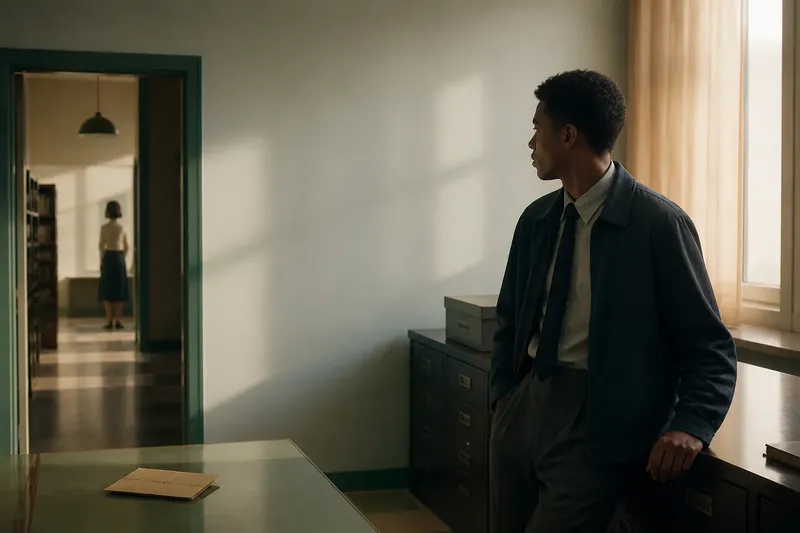
Say you are composing an invented scene in which a clerk stands near the right edge of a records room, looking left. A sealed envelope rests on a desk in the space between the clerk and the left edge. If the envelope is clear enough to register but not so prominent that it overwhelms the face, the viewer’s attention can travel from the clerk to the document and back. The observable result is a shot that makes the relationship between person and object legible without placing either at the exact center.
For a simple viewing exercise, follow the eyes before deciding what the shot wants you to see.
3. When does an off-center figure make a relationship visible?
Two people need not occupy matching halves of the image to feel connected. Their distance, relative scale, and orientation can make a relationship visible before either speaks. One character near the foreground and another farther back may appear divided by the room; if both turn toward each other, that separation can also become a line of connection.
Unequal placement can suggest an imbalance without reducing a scene to a diagram. A character who fills most of one side of the frame may appear to dominate the space, while a smaller figure at the opposite edge seems to have less room to act. Yet posture can unsettle that reading. A compact figure standing squarely, facing the larger one, may seem more resistant than the difference in scale initially suggests.
Frames within the image—doorways, railings, desk edges, or the vertical line of a curtain—can make the relation more specific. A partition between two characters gives their separation a physical form. If one person is framed by a doorway while the other stands in the room, the doorway can read as a boundary, an exit, or a point of possible meeting. The set’s geometry is doing compositional work, not merely filling the background.
In a two-person shot, look at the gap between the figures as closely as their expressions.
4. What can a frame edge do to a subject?
An edge is not just where the picture stops. It can make a subject feel contained, threatened, overlooked, or about to leave. A face placed close to the border may seem crowded even in a spacious room. A figure partly cut off can suggest that the camera has arrived late, that someone else occupies the unseen area, or that the character is not the sole concern of the shot.
Cropping needs context. A hand cut by the frame can look incidental if nothing else draws attention to it; paired with a sharp gesture or a second person watching, it may become the image’s quiet focus. Likewise, placing a character near the edge does not automatically communicate anxiety. A relaxed pose and balanced surrounding shapes may make the position feel natural rather than tense.
The edge can also create a useful question about what lies beyond view. A person looking out of frame makes the unseen space part of the composition, while a person looking into the lens may seem to challenge the viewer’s position. In both cases, the border helps define the relationship between what is visible and what is withheld.
Notice what the frame excludes, especially when a character appears to respond to it.
5. How do movement and balance keep an image from feeling lopsided?
Off-center composition is not the same as careless imbalance. Visual weight can come from brightness, contrast, shape, color, detail, or movement. A face on one side may be balanced by a bright lamp, a doorway, or a group of figures on the other. The elements need not match; their different kinds of weight are what make the arrangement interesting.
Movement changes that balance over time. A character may enter a shot at the edge, pause, and move toward an open area without ever crossing the center. The motion directs attention through the frame and can alter the meaning of the space the character leaves behind. A still object can gain importance when a moving figure briefly clears the line of sight to it.
Camera movement can make the same placement feel different. A pan that follows a person may keep them near the edge as the environment unfolds, inviting attention to what they pass. A stationary camera may instead let the person leave the frame and hold on the remaining space. The second choice can make the absence itself the subject, though the meaning still depends on the scene’s other details.
When a composition feels lopsided, check whether the imbalance is purposeful: does it emphasize a movement, object, or absence?
Which questions help you read off-center composition?
Does the center of the frame always hold the main subject?
No. A face or object may be placed elsewhere while gaze, contrast, movement, or empty space carries the viewer’s attention. The center can be visually quiet, or it can be occupied by a detail whose importance emerges only in relation to the subject.
Why might a filmmaker leave space beside a character?
The space may suggest a direction of attention, a possible entrance, distance from another person, or an absence that matters. Its meaning comes from how it relates to the actor, the set, and the action rather than from emptiness alone.
Can an off-center shot still feel balanced?
Yes. A smaller bright shape, a doorway, or a second figure can counter the visual weight of a person near one edge. Balance is a relationship among elements, not a demand that the image be symmetrical.
What should I look at first when analyzing a film frame?
Notice the most obvious subject, then follow any gaze, gesture, or strong contrast away from it. Look at the edges and the space between figures; those areas often reveal what the composition is asking you to consider.
Why is the center still useful?
Centering remains a precise choice when a film wants a character to confront the viewer, appear isolated within a symmetrical setting, or command a stable, formal image. The point is not to avoid the middle but to recognize that placement changes the terms of attention. A centered figure can feel exposed; an off-center one can feel powerful, incidental, or suspended between competing parts of the frame.
To read a shot, identify where the eye lands first and where it travels next. That second destination may be the image’s more revealing one. Off-center composition is useful because it lets a film give a subject room to matter without making the subject occupy every inch of our attention.